
WHAT IT FEELS LIKE TO KNOW SOMEONE
New York, May 2026
The truth is, I take something away from every interview I do with an artist – a phrase, a concept that particularly strikes me and sometimes keeps me thinking for months afterwards. With JENNA GRIBBON, it’s the notion of getting to know someone over the years that stays with me – an endless process that delves into the many layers that make up intimacy.
For the past ten years, the renowned American painter has made her wife, the singer and performer Mackenzie Scott, an ongoing subject whom she continues to portray with sincere beauty. With her mastery of figurative painting that challenges conventional representations of the woman’s body, Jenna Gribbon’s work embodies both what the female gaze and queer art can be – “the ability to rewrite the rules and do things in unexpected ways”.
With her new exhibition set to open in August at the Rose Art Museum, we talked about the evolution of her work, from intimacy to feminism, and, of course, connection.
Full looks Corban Harper
When did women start to take an important place in your life, both artistically and personally?
Women have always been more drawn by women than by men, in every way. I remember as a child watching movies and not being interested if there weren't any girls in them. I've painted men over the years, but I've always been more interested in female subjects. In the last few years, I've focused almost exclusively on painting my wife, so the work has become even more woman-specific, although she herself is gender fluid. I also paint my male child a lot.
In painting, I'm trying to describe my experience of moving through the world, and that experience is as a woman. So even when I'm painting Mackenzie, she often becomes a kind of proxy for me — a way to describe something I've felt, what it means to be a woman in the world and to be looked at. It's about making paintings that describe that experience.
Full looks Spirit Body by Erik Bergrin
Why did you decide to focus more specifically on your wife? What does she embody for you?
It happened gradually. I started painting her pretty soon after we met, in 2017. She's a great subject with a captivating energy. I'm interested in her androgynous quality, which isn't something we've seen much of in painting. The more I painted her, the more I enjoyed the evolution of the project, and the more familiar my audience became with her. She became a kind of cumulative subject – the more paintings I make of her, the more interesting they are to me, because I'm building on everything I've painted of her before. In the end, the project translates the process of looking and re-looking, trying to see my partner and describe what it feels like to know someone intimately.
Does the act of painting feed into the relationship itself?
Totally. We have what I often describe as a kind of reciprocal "musedom" – she writes about me or about our relationship in her songs, and I paint her. We're always talking about these things. It's easy for me to say, "I'm going to take some reference photos now," or for her, "Listen to this song, what do you think?" Our relationship is essentially about making these things together, so the work is deeply integrated into our lives.
Left Jacket and sweater Prada, denim Tibi
Right Shirt and pants Fendi, cowboy hat Mackenzie’s own
You do sometimes appear in your work, too. What is your relationship with your own image?
I don't make many straightforward self-portraits. I made one for my show at MASSIMODECARLO in Milan last year – the first in over a decade. More often, I appear in paintings with Mackenzie, but only the parts of my body I can actually see. Since the paintings are about my own experience, I show myself the way I experience myself. In the series of projection paintings, there's a photograph of me, taken by Mackenzie, projected onto her. So, everything is mediated. My presence is there, but you don't often see me directly.
My relationship with my own image is one of ambivalence. I don't really enjoy looking at myself and feel pretty uncomfortable being looked at, which is partly why I wanted Mackenzie in the photo shoot in the first place. She's a performer, and she enjoys being in front of people. She also understands where I come from, and sometimes she'll act out a feeling of discomfort to express something I've described to her about my own experience of being looked at, which is where many of the paintings come from: a bright light shining in her eyes, or her covering her face, to convey that discomfort.
Jenna Suit, shirt and belt The Frankie Shop, shoes The Row
Mackenzie Shirt and pants Issey Miyake, shoes Jil Sander, socks stylist’s own, cowboy hat Mackenzies’ own
I relate a lot to this idea of representing someone while trying to express what actually comes from ourselves, and to channel that through the other person.
Exactly. I think that's often what happens when women paint women, and it's part of where the difference between the male gaze and the female gaze comes in: a woman painting a woman is often painting her own experience of being that figure.
Do you think there is a feminist and a queer way of painting today, particularly given how women's bodies have historically been objectified in art?
I'd describe each a bit differently. For me, the feminist way to paint is to be fully in your power as a woman making the painting, and to paint unapologetically. I think it can be a trap to paint only in reaction to the problematic ways women have been depicted in the past. If you focus only on that, you can reach a point where you can't make a painting at all. So, my conclusion was to move forward with an awareness of those problems, without painting in reaction to them. As for queer painting, I'd say queerness is about a shift in perspective – the ability to rewrite the rules and do things in unexpected ways. There are infinite ways to make art that is queer.
Left Top Eckhaus Latta, shorts Maison Margiela
Right Painter jacket Jenna’s own, T-shirt underneath Organic by John Patrick, pants Maison Margiela
Can you remember when you started to make queer art?
As women, we grow up trained to be sensitive to others' wants and desires, while treating our own as secondary. I had a lot of work to do to understand my own desires and give them much attention. Painting about queer desire was part of a process of understanding myself – I think a lot of us make art to understand something we can't see until it's put in front of us. I started making those paintings during a period when I was trying to understand my own desires, so they emerged organically rather than as a deliberate statement. I hadn't seen many depictions of queer desire I related to, so I felt I had to make them myself.
Left Full look Spirit Body by Erik Bergrin
Right Full look Corban Harper
You said you met Mackenzie in 2017, almost ten years ago. Can you see a difference between the themes you painted back then and now?
Definitely. The first paintings of her and of us were more about queer desire in a general sense. As the project evolved, the work became more specifically about her, while simultaneously becoming about something more universal – once I felt I understood my own desire, I was able to move into deeper questions about what can possibly be known about another human being you're close to, and what that journey looks and feels like.
Our society today is mostly organised around the fear of the other. Your work accrues the opposite: the faith in the process of truly knowing someone. Do you see your practice as a way of finding hope through connection?
Yes. I think our connections to other human beings are the most fundamental, important thing we have. If anything will save us, it's seeking real connection – having empathy, a genuine desire to understand other people's reality, and a willingness to be vulnerable in the process of finding the truth of another person.
Left Coat Prada, socks stylist’s own, shoes The Row
Right Shirt and pants Spirit Body by Erik Bergrin , boots Maison Margiela
That brings us to your upcoming show, which will be about connection, right?
Definitely! The show is called Entwined. That's also the title of a painting I made of my son and me, but it relates to all of my work. This exhibition will be about our entwinement with other people, about how it's almost impossible to parse out where you begin and another person ends within a close relationship – how much of what you think just happened actually comes from what the other person said or did, and how much you're bringing into the situation yourself.
It's a survey show with about forty paintings – three new ones, including new projection paintings alongside a lot of older work. Much of it is from the last ten years, but the oldest painting is from 2001. I think it will be interesting for people to see where I was coming from and how the evolution of a painter can look over time.
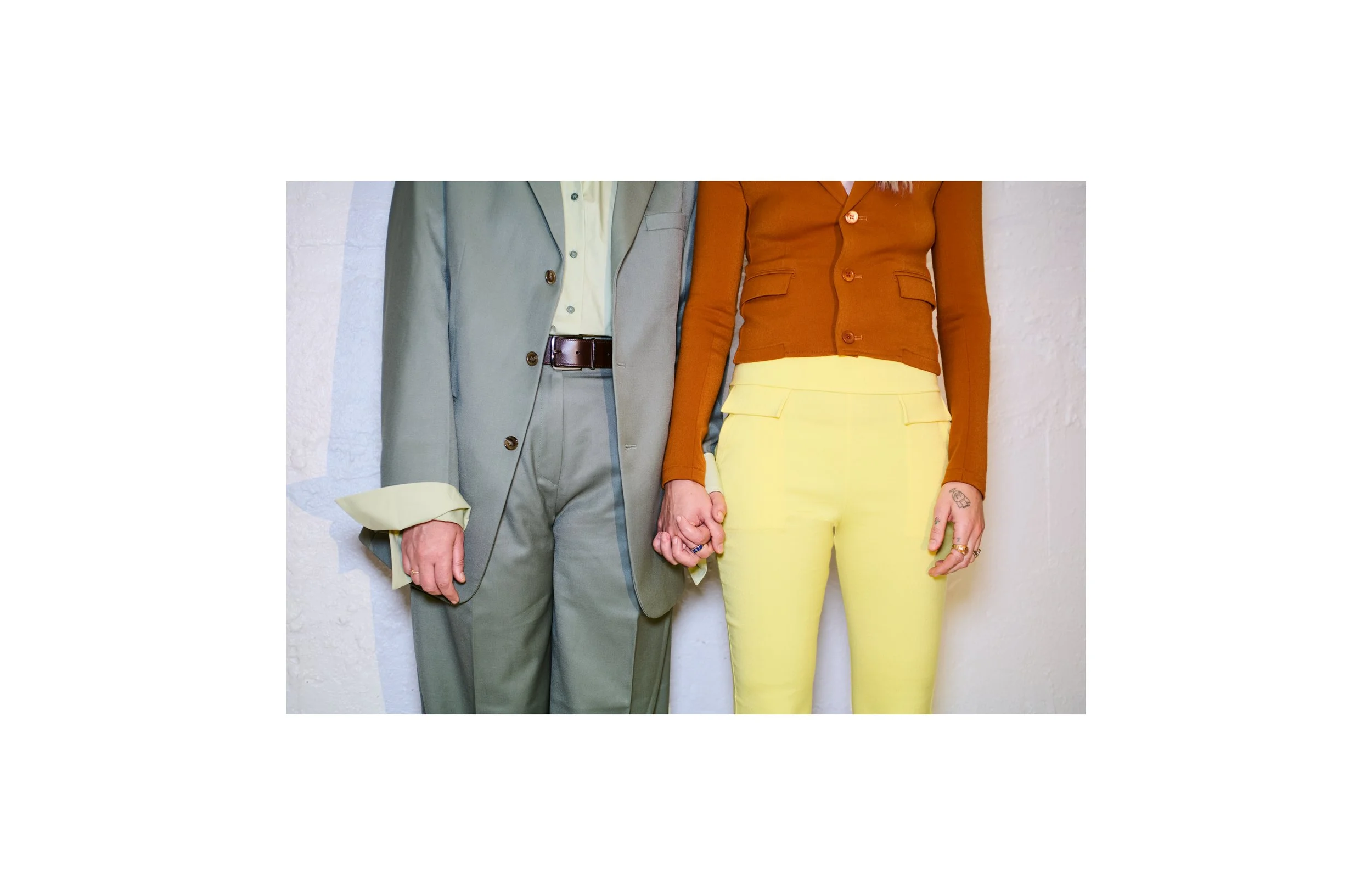
Jenna Suit, Full look The Frankie Shop
Mackenzie Full look Issey Miyake
You mentioned your son. Do you intend to keep painting that relationship with him as well?
Absolutely. As long as he's interested and willing to be painted, I'll happily continue. It's another exciting project where I get to chart someone's evolution over a long period. In some ways, that relationship may be the hardest of all to separate yourself from, in terms of how you think about the other person – parents often project themselves onto their children, and I try hard not to do that, to see him as much as possible for who he is as an individual, rather than seeing myself in him.
Final question: how do you perceive beauty today?
I really enjoy beauty, and I think our contemporary culture is somewhat starved for it. It's interesting how beauty has become almost taboo in art for a while, which only makes it more interesting to me. I've spent a lot of time in my garden over the last couple of years, and being around plants and flowers clarifies how intrinsically important an experience of beauty is for a human being. What isn't beautiful are the beauty standards imposed on women, which are fake and don't reflect how beauty actually operates – like a fake flower next to a real one. A real flower is beautiful as a bud, in full bloom, and even when dried or gone to seed at the end of its cycle. I'm interested in beauty that speaks to our higher selves, in every state.
It's interesting because Mackenzie is conventionally beautiful, but she's also a great subject because she's willing to appear in the paintings without being overly posed or polished. I really appreciate that about her, and I look forward to following her on a lifelong journey, as her body changes over time, and that becomes part of the project – like Joan Semmel, who is still painting herself in her nineties, and whose paintings only get more beautiful.
The show Entwined by Jenna Gribbon will be on view at the Rose Art Museum from August 19th, 2026 to January 3rd, 2027.
Interview of Jenna Gribbon by Hanna Pallot
Photography by Kotaro Kawashima
Fashion by Michael Andrew Rosenberg
Featuring Jenna Gribbon & Mackenzie Scott
Hair by Rei Kawauchi at Bridge Artists
Make-up by Yuko Kawashima
Photographer’s assistant Yumi Shimizu
Stylist’s assistants Marissa Nanarone & Leah David