
THE VIVID WORLD
London, September 2026
For DAICHI TAKAGI, looking is a way of letting the world reveal itself anew. His paintings begin with familiar, organic sights – trees, stones, rain, leaves, the moon – but through sustained attention, these forms gradually shed their fixed meanings. What remains is more elusive: a moment of pure experience, where the boundary between observer and observed begins to dissolve.
Working with meticulous brushwork and a meditative level of patience, the Japanese artist transforms close observation into images that feel suspended between the tangible and the dreamlike. His latest exhibition, Suchness, at David Zwirner in London, takes its title from the Buddhist concept of reality in its ultimate nature, before name or form become attached to it. Across the works, darkness becomes both void and origin, while repetition becomes a means of encountering difference.
Here, Takagi reflects with us on perception, nature, and the possibility of seeing without judgement.
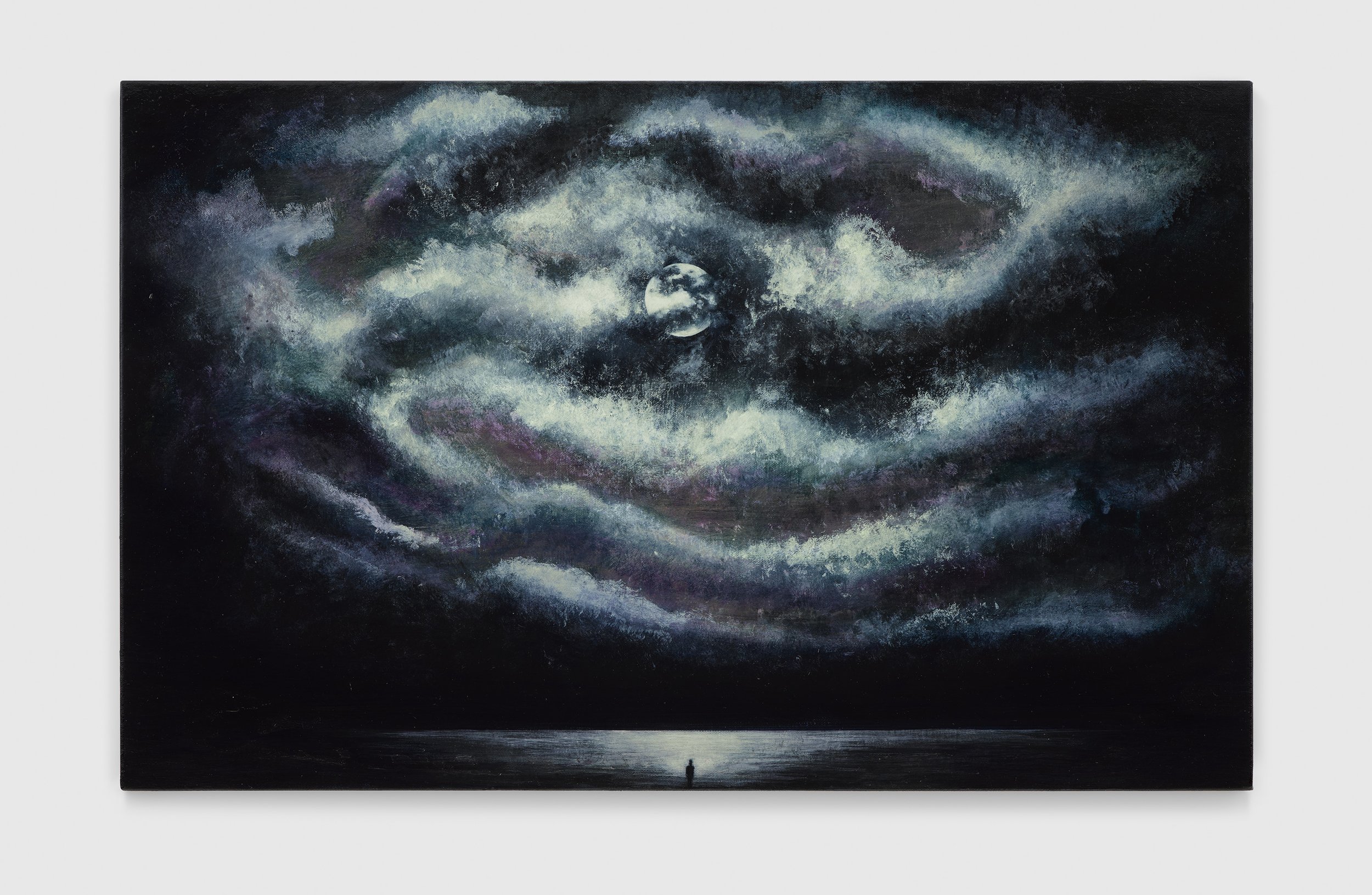
Wanderer, 2026, Oil on canvas, © Daichi Takagi, Courtesy Kayokoyuki, Japan and Ramiken Crucible, New York
The exhibition is titled Suchness, a term that describes things simply being as they are. What does “suchness” mean to you in relation to painting?
“Suchness” is a Buddhist term translated as shinnyo (真如) in Japanese. In that context, it refers to “reality in its ultimate nature, without name or form.”
My practice begins with encountering and perceiving things as a pure experience. Rather than making myself the subject and controlling what I see through my expression, I try to move away from the way of seeing that fixes an object, encountering and perceiving things as “this is what it is,” before it has even been conceptualised.
If I look at something for a long time, I begin to notice the irregularities on the surface of a stone. I see subtle colour changes. As time passes, my perception of it changes. I lose the sense of what the thing before me actually is. I become unsure of what the act of looking itself is. I realise that each moment of looking can only occur once, in that particular moment. All kinds of thoughts and fantasies begin to unfold.
In this way, the boundaries between subject and object, between inside and outside, no longer remain fixed, and the world emerges as something vivid and immediate. I use the title Suchness because I want to fix in the work the very state in which these kinds of experiences occur.
Trees, stones, rain, leaves and the moon recur throughout your paintings. What is it about these very ordinary elements of the natural world that keeps drawing you back to them?
These motifs are, in reality, never exactly the same twice. They can look different from one day to the next, and our experience of them can change as well. I think this tendency is particularly strong in organic things found in nature. Symbolically or conceptually, we may see them as the same thing, but they carry relatively little narrative or cultural meaning, which makes it easier to return to the act of seeing itself. So even if I paint similar stones or trees again and again, I never feel that I am painting the same thing. I am interested in how a different experience emerges each time.
Your paintings can be extraordinarily precise while simultaneously feeling dreamlike or almost unreal. How do you negotiate that space between observation and imagination?
As I mentioned earlier, when I simply look at a tree or a stone, a different kind of time can emerge from what I normally think of as reality, or a different sensation can arrive. In those moments, I feel a great sense of beauty, I am emotionally moved, and I feel that I am experiencing the rich capacity of human sensibility in its true sense. Since I am trying to fix that sensation in a painting, I am honoured that you have sensed something dreamlike or imaginary in the work.
There is the idea of “pure experience” in the work of the modern Japanese philosopher Kitaro Nishida, as well as a sense of funi, or non-duality, in Eastern thought, which does not regard the boundary between the self and the world as fixed. It is nothing particularly extraordinary, but rather a direct experience that exists before the distinction between subject and object, between the one who sees and what is seen. This is how I see and experience things.
I want to capture that pure experience, that moment when sensibility is at work. In that moment, things exist before they are divided up through concepts or meanings, and the moment itself needs to be experienced. There is no need to understand or judge anything. Even though you are looking at reality, another kind of time or sensation begins to emerge from it. As that boundary becomes blurred, I think it can also begin to feel like drifting through a dream.
There is a Japanese poet named Kenji Miyazawa, and in the descriptions in his works there is a feeling that the boundary between reality and dreams gradually disappears. Rather than going from reality into another world, there is a sense that another time or space begins to emerge, almost without you noticing, from the very experience of looking at reality. It is not pure fantasy. By looking deeply into reality, another world, almost like a dream, begins to emerge from it. Each of these experiences is connected.
It is difficult to sustain this kind of experience in everyday life. So I consciously go to places where I can more easily have a pure experience, or I spend time alone to remember what that state feels like.
There is a striking darkness in many of these works. What does it represent for you?
One of the descriptions that expresses my image of darkness is the word xuan (玄) from Laozi’s Tao Te Ching. Xuan is described as “a dim, immeasurably deep state,” and is regarded as a profound place, like a womb, from which all forms of life emerge.
It is a very, very deep darkness from which life can emerge, but it is also a darkness like the endless expanse of outer space. When you walk through the mountains without any lights, or look out at the sea at night, you may feel fear at the depth of the darkness, but you can also feel a sense of peace or positive energy there. This is how I approach darkness in my work.
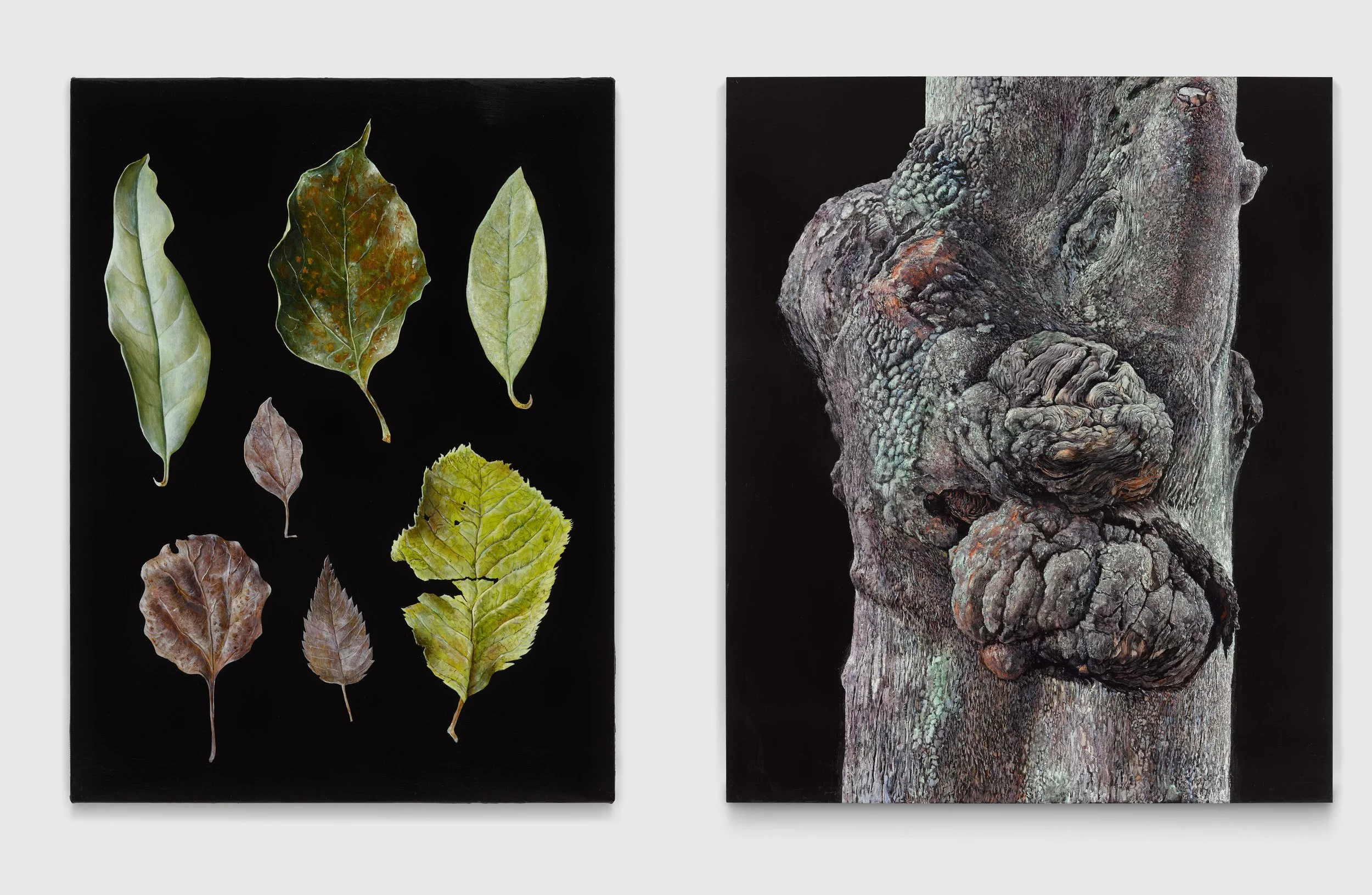
Left Leaves, 2026, Oil on canvas, © Daichi Takagi, Courtesy Kayokoyuki, Japan and Ramiken Crucible, New York
Right Trunk , 2026, Oil on canvas, © Daichi Takagi, Courtesy Kayokoyuki, Japan and Ramiken Crucible, New York
In works such as Stone or Trunk, you bring us extremely close to your subjects. What happens to an object when you isolate it from its usual context and ask the viewer to look at it so intensely?
When we were children, I think many of us shared the experience of simply picking up a stone for no particular reason and staring at it. That experience, cut off from everything else, from the past and from the future, can feel eternal, and yet it is also an irreplaceable moment. The object and I become connected, and I begin to dissolve into it as an element of the universe.
Your brushwork is incredibly delicate and controlled. What do repetition and patience contribute to your practice?
Even in the repetition of everyday life, even when I seem to be continuing to paint similar things day after day, there is never the same day, the same time, or the same moment. That is simply what our everyday lives, and our lives as a whole, are like. And yet there are moments when I feel beauty in that.
I think of Morandi, who changed the arrangements and compositions of his still lifes and painted them again and again. I think of On Kawara’s Date Paintings, each marked with a date, among which there is never a single identical day. And the paintings of Fra Angelico, made with a straightforward sense of prayer, are simply sacred. I also think of the Buddhist statues carved by Enkū, who continued to make them in different places while travelling on pilgrimage and practising within the Buddhist path.
For me, repetition and patience are not about doing the same thing over and over, but about continuing to face a different experience each time. Rather than pursuing an expression that is overly centred on myself, or becoming self-indulgent, I accept the experience of confronting the object and paint it with precision. Through this, I feel that the work can give the impression of becoming connected to a great presence.
Do you work from direct observation, memory, photographs, or some combination of these? And does the source matter once the painting begins to take shape?
I use all of these in my practice: direct observation, memory, photographs, and a combination of them. If it is a stone or a small piece of wood, I will bring the actual object home; if it is a landscape, I will take photographs.
But rather than painting from the photographs, I record them more like notes that can awaken the memory of the experience. Once the painting begins to take shape, these sources are transformed into inner images, and it no longer matters where I saw them or what they originally were.
Your paintings invite extremely slow looking. In a culture saturated with images and constant visual information, does slowness feel increasingly crucial to you?
Yes, absolutely. The experience of “looking” is extremely important. Of course, I am also a person living in the contemporary world, so like everyone else, I encounter visual experiences every day through photographs, images, and videos viewed on screens. But if I want to sense the vivid emergence of the world, before subject and object are separated, where the boundary between inside and outside is not fixed, and to go deeper, deeper into that experience, then I think it is necessary to simply look slowly and feel. Through my work, I want people to experience painting as a material thing, and the space in which it exists, over time.
Daichi Takagi’s show Suchness is on view at David Zwirner London from September 24th to October 31st, 2026.
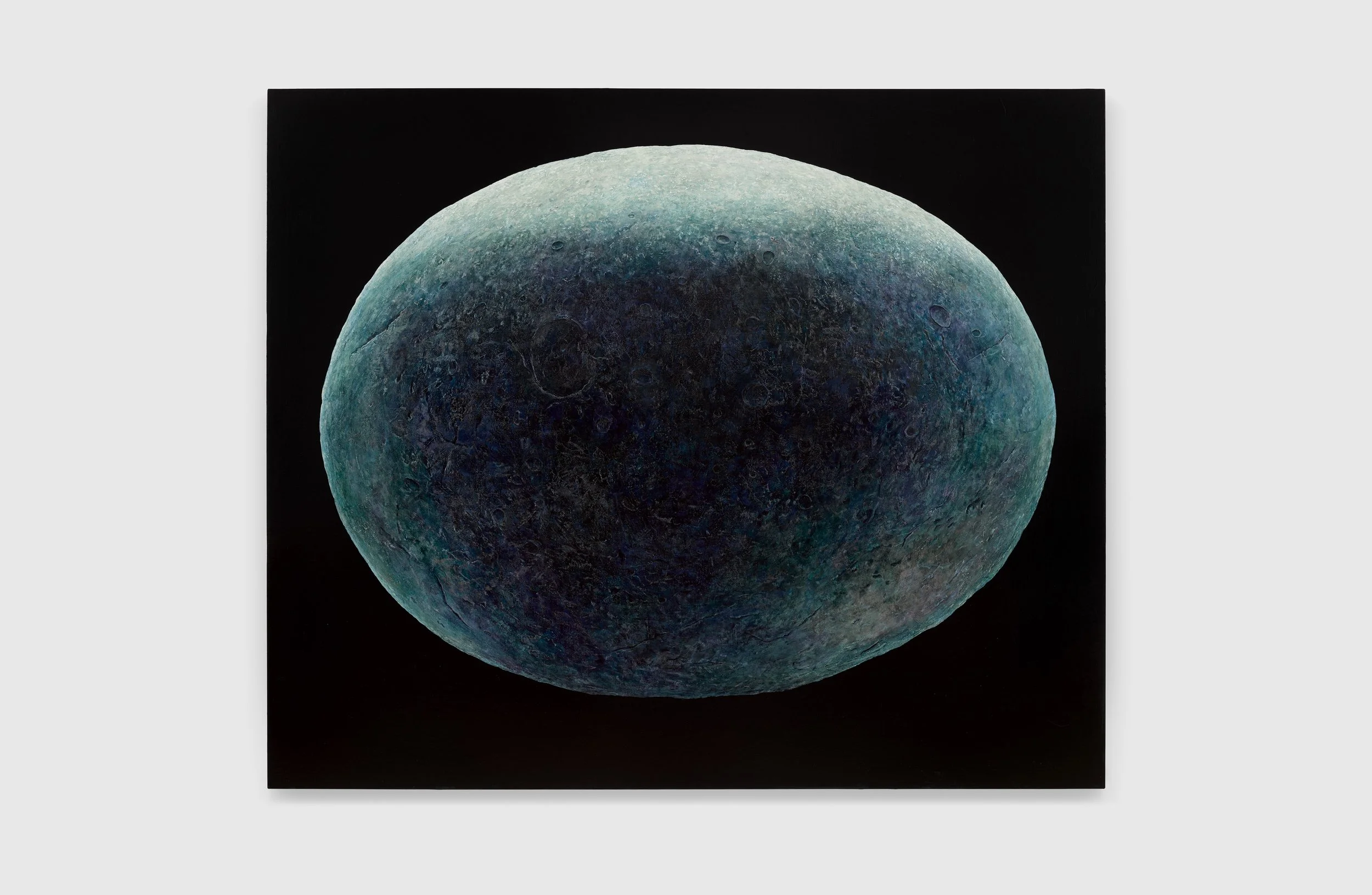
Stone, 2026, Oil on canvas, © Daichi Takagi, Courtesy Kayokoyuki, Japan and Ramiken Crucible, New York
Interview by Martin Onufrowicz