WHICH AMERICA?
Brooklyn, June 2026
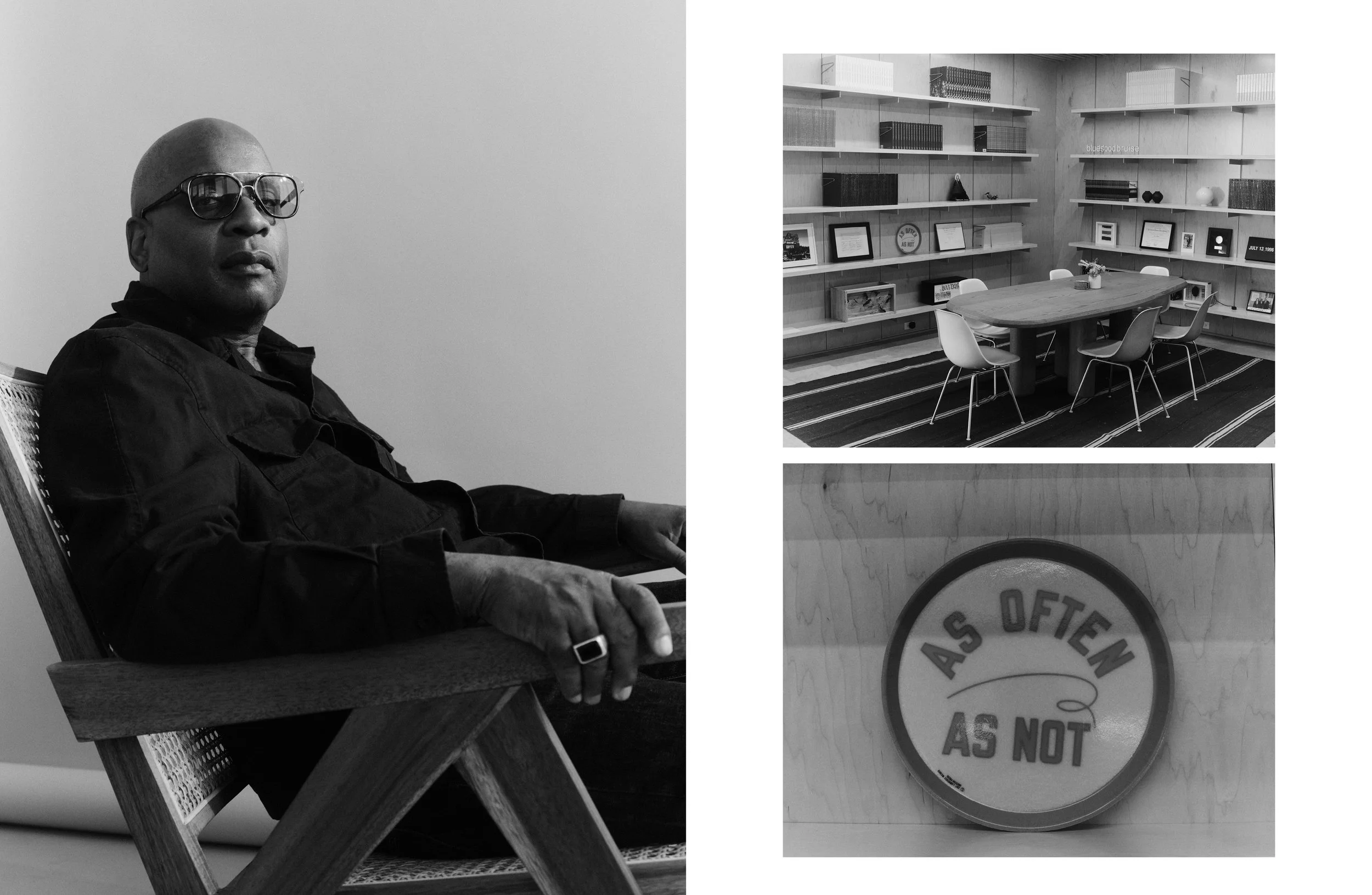
GLENN LIGON has spent nearly four decades turning language into image, pulling from James Baldwin, Zora Neale Hurston, and Richard Pryor to build paintings, neons, and prints that interrogate American history, race, and identity. His 2011 Whitney retrospective, AMERICA, cemented him as one of the de!ning artists of his generation, and his work now lives in the permanent collections of MoMA, the Whitney, Tate, and the Centre Pompidou. But none of that comes up right away. Before we get into any of it, Ligon is just easy, warm, and generous with a laugh. We are talking from his studio in Brooklyn on a summer morning, and within minutes, he is already riffing on old photo shoots, doing a spot-on impression of a photographer's accent mid-story.
Right Glenn Ligon, Malcolm X, Sun, Frederick Douglass, Boy with Bubbles (Version 3) #2, 2001, Silkscreen ink, Flashe paint, and gesso on canvas, © Glenn Ligon, Courtesy of the artist, Hauser & Wirth, and Thomas Dane Gallery, Picture by Sarah Muehlbauer
I saw you were in Chicago last week at the opening of the Obama Presidential Center. How was it?
Very good. I'm installing a neon there. It isn't up yet, but I didn't want to miss the chance to meet the Obamas!
How are they?
[Laughs] They seem fun, excited about the Center. It's quite magnificent and very generous to the surrounding community. There is a library, a basketball court, a test kitchen. A whole campus, really.
I bet. And what's the neon work about?
An American neon.
Right Glenn Ligon, Harriet Tubman (Version 1) #1, 2000, Silkscreen ink, oil stick, and gesso on canvas, © Glenn Ligon
Perfect timing. I wanted to talk about America, it's such a rich point of departure for understanding your work. Every time I pass one of your America neons, it hits differently, maybe because it's so tied to the moment. What is the America neon today?
True. It sort of is like what it was when it started, this very ambiguous word nobody agrees on the definition of. It's mutable. It depends on what America you are talking about. There's a scene in a movie where there is a civil war, and journalists are trying to get to Washington to cover the president. They get stopped on the road, and one of them says to their captor, "We're all Americans." And he says, "Well, which America?" It's kind of like that. Which America are you in? Jasper Johns famously said, “Take an object, do something to it, then do something else to it.” My version of that is to take a word and do something to it. That word is so ripe for reinterpretation, for flipping upside down, for blinking on and off, annoyingly, through all its possibilities.
Speaking of reinterpretation, do you ever see a work get used in a different way? For instance, "America" being co-opted?
Yes actually. There's a piece called Double America, a blacked-out America, flipped upside down. I saw an Instagram post recently where this woman was, I don't know how she managed it, in a museum, in front of the work, doing some kind of dance pose. I was like, where are the guards? And the caption underneath, with her kneeling in front of it, said, "Support our troops."
And I thought, nothing says "support our troops" like America blacked out, upside down, and backwards. So how people read the work is kind of fascinating to me. Like, what about that seems patriotic to you? I can't control how people read the images; it triggered something in her. It's the same with words: the weight of how each person interprets a word. People come to it with their own understanding.
Left Paintings from Ligon’s Coloring Book series, © Glenn Ligon
Interesting. You also have a show opening at Hauser & Wirth in LA at the end of September that looks into notions of interpretation; it’s a rarely seen body of work from a residency in the early 2000s…
Yes, it was a residency at the Walker Art Center in 2000, and part of the mandate of that residency was to work with communities within a three-mile radius of the building. Minneapolis has immigration from all over the world, but rather than working with specific ethnic groups, I decided to work with kids. So we contacted daycare centres with children from three to six years old, and I gave them these Afrocentric colouring books from the late sixties and early seventies. This was the moment when Black educators were trying to figure out how to normalise Black heroes for kids in public schools, who they felt weren't being taught this history adequately. So the colouring books had all the usual things you would find in such books, but also images of Malcolm X, Harriet Tubman, or Frederick Douglass, as a way to introduce and normalise those figures for kids. I had the kids draw on those colouring books, and then I made paintings and drawings based on how they coloured them in. All of my work comes from an external source, so it didn't make sense for me to just make colouring-book paintings myself; I needed a source. The kids' drawings became the source material.
Left Artwork by Luca Glenn Wataya, © Luca Glenn Wataya
What made you return to this work now?
Twenty-five years after the fact made it interesting to show this colouring-book work now. What will that work mean today? I'm curious; I don't know yet. How will people read an image of Malcolm X with lipstick and eyeshadow? I know how they read it at the time.
How was it back then?
There was still a bit of explaining that had to be done. So it's curious to see, after all these years, we are in such a different political landscape now, in the Trump era.
You mentioned the word ‘source’ earlier; it made me think of the way you operate in the studio, where you start something and then you keep adding to it.
Yeah, as I said, all the work is quotation, all the text work. There's always source material that's the basis of the work, and I extrapolate from there. For instance, I have used Baldwin's Stranger in the Village for many years. Recently I have been thinking about my relationship to that text as more like a ground. Imagine a painting: you start with a white gesso ground, then make marks on top of that. Well, now I think of Baldwin as the ground. The last show at Hauser, those blue drawings, really used that text as the ground to make abstraction, basically. So it's a different relationship. It's not so important to me that the text is legible in the work, because it's legible in the world. Google has made that possible. So the work can do something else, be more about mood, atmosphere, or colour.
This reminds me of one of my favourite artists, Etel Adnan – she would always start with a small red square on her paintings, and then paint from there. Do you keep something like that, a recurring anchor, a recurring book you accumulate?
I have been going back into my own book archive. A few weeks ago, on my way back from the opening of the Venice Biennale in the airport on the way home, author Christina Sharpe introduced herself to me and said, "You wrote an essay about this artist Hurvin Anderson who has a show at the Tate Britain right now, and you quoted my partner, Dionne Brand, who's a poet and essayist and she is here, she would like to meet you."
So she introduced us both, and we ended up talking about that essay. Sharpe's book, In the Wake (2016), is very well known, and the Dionne Brand book I was quoting from is A Map to the Door of No Return (2001), which is about thinking through what it means to be in diaspora. Amazing books, both of them. When they were walking away to catch their flight to Paris, I actually got teary-eyed because I thought: I'm part of something. That these two well-known, incredible authors took the time to come over and introduce themselves to me because they recognised a text, it's kind of amazing to realise you are part of something, I guess generally you would call it Black studies, and that you have a role in it somehow.
Top left Paintings from Ligon’s Coloring Book series, © Glenn Ligon
Right © Glenn Ligon
That's a beautiful airport story. I was also at the Biennale opening. What did you think of the show?
I thought it was… a little bittersweet because the curator Koyo Kouoh had passed away. I remember being at a Biennale years ago, in Venice, and someone said that the thing about curators who are still around when a show opens is they throw in wild cards, suddenly there is a Louise Bourgeois spider that wasn't on anybody's checklist, but there it is! So we missed that sense of intervention this time. But what I liked about this Biennale was that I didn't know most of the artists. There was a real attempt to look at the Global South seriously and to bring a lot of artists together. It makes for hard going; you have to read all those wall labels. [Laughs] It was dense, crowded. In three days, I didn't get through all of it, and I hardly saw any of the national pavilions. I saw some of the other shows instead. My partner [artist James Hoff] also did a score for Lawrence Abu Hamdan's film piece, which was so good.
Oh, I saw that; it was very beautiful as part of Canicula, the trilogy show curated by Alessandro Rabottini. He is always so meticulous.
Yes, there was real attention to how things were displayed and the procession through the space. I think there were nine video installations, but it felt very seamless.
I mean, that's the problem with all Biennales, you can't really see it all. I always take photos of the wall labels and read them on the plane back.
Nice, That's a good idea!
Might you ever do a work about labels or annotations? It feels like it’s so much a part of your work somehow?
Actually, it's interesting you say that, because I think annotation is an interesting way to talk about it. For one thing, it implies that artworks aren't stable. So often when I'm working with annotations, it's about revisiting an existing work and rethinking it through that process. It's a way of pushing back against the idea that once an artwork goes into a museum, that's it, forever, that it's the museum's job to keep it the same. But we know artworks change depending on who's viewing them. Different generations look at the same artwork very differently. I'm interested in that process: how artworks shift over time.
Also, I come back to things over and over again, like James Baldwin's essay. That essay was written in the early '50s, and every year I read it, I find something new in it. It has a different resonance now, because Baldwin is so present in the discourse at the moment. When I first read that essay, he wasn't part of the conversation in that way. So I'm interested in how the same text gets used differently over time. Annotation is an interesting way to get at that. I use it in exhibition spaces too. I did a big show at The Fitzwilliam Museum in Cambridge, and a lot of that was about annotation, about someone taking their collection and, through juxtaposition, reading it differently.
I read somewhere that you see artists as ‘wind sniffers’, sensing what's coming. What do you think is coming?
[Laughs] I think artists are indeed often very attuned to what's coming, not just what is. I don't know if I have a good example of that, but I feel it in the conversations I have with artists. A couple of years later, I'm like, oh, they totally nailed that. It's not coherent, not inside knowledge exactly, just a feeling for what might be coming, and what might be useful to the world that's coming.
Any predictions?
[Laughs] I'm not in the prediction game. But there's a beautiful quote – I'll send it to you [Ligon did follow up after the interview to share the exact quote he was referencing]. Teju Cole wrote an Instagram post about Baldwin, about how in his lifetime Baldwin was vilified for his sexuality, for not staying in America, for being seen as politically out of touch. But Cole ends by saying Baldwin was writing for the future, for audiences that hadn't been born yet. I love that idea. Your audience will come. It may not be there now.
Left Glenn Ligon, Redacted #13, 2026, Oil stick and gesso on canvas, © Glenn Ligon, Courtesy of the artist, Hauser & Wirth, and Thomas Dane Gallery, picture by Ron Amstutz
Beautiful. Any New York City tips? Where in the city do you go to, museum-wise? I know you're often at the Whitney, where you had your retrospective, "AMERICA," back in 2011.
The Studio Museum, obviously, has a new building that is spectacular. In the old space, they could really only mount one or two shows at a time; now they can run five. It's made the place so much livelier. The Studio Museum always had an audience, but every time I have been up there since it reopened, it's packed. The MoMA, too, of course, there is always something pulling me back. Two years ago, it was the Jack Whitten retrospective. It was amazing, I went a bunch of times. There was this Whitten painting, Atopolis: for Édouard Glissant (2014), that stayed up in the permanent collection for maybe six months. I would come every month just to see it. Then, on one visit, it was gone, replaced by a huge Julie Mehretu painting. I remember thinking, "Well, somebody got the memo." One masterpiece after another.
You grew up in the South Bronx, right?
Yes! I have always been here, and I can't picture living anywhere else. Pretty much everyone I knew left the minute they graduated from high school. This was the '70s, New York was rough then.
There is that J.Lo line going around Instagram claiming that if you are not born in New York, you are not a New Yorker.
[Laughs] I don't know if that's true anymore, but it's funny. Growing up in the Bronx, "New York" meant Manhattan. We would say "we're going into the city today," like the Bronx wasn't part of New York City. Manhattan was the goal. And J.Lo's from the Bronx, so she should know! [Laughs]
The solo show Sit So Your Back Isn’t Against The Door by Glenn Ligon will be on view from September 30th, 2026 to January 17th, 2027 at Hauser & Wirth Downtown Los Angeles
Interview by Ibrahim Kombarji
Photography by Erik Tanner