A MATTER OF CONNECTION
Amsterdam / Paris, September 2026
Gus Van Sant, Kim Grodon, Yohji Yamamoto, Nan Goldin, Sonny Hall, Michael Pitt, Beth Gibbons – these are only a few of the big names that YAËL TEMMINCK has photographed in recent years in his distinctive style of square-format black-and-white portraits. After years of collaboration with publications such as Behind The Blinds and SHADOWPLAY, the Dutch photographer just launched his first monograph, Yaël Temminck (Anthology), which features over 120 portraits of artists, personalities, models, and more.
On the occasion of an exhibition alongside the book release in Antwerp, Temminck met a fellow photographer from the SHADOWPLAY team, Hanna Pallot, bringing together a dialogue around portraiture, connections and collaborations.
Left Nan Goldin, 2023
Right Sonny Hall, 2024
Hanna Pallot: Hello Yaël, how are you? Where are you?
Yaël Temminck: I'm good! I'm in Amsterdam. It's rainy today. Are you in Paris?
HP: Yes. I moved back last May.
YT: Paris is probably more exciting for you in terms of work.
Left Pol, 2025
Right Olivia O, 2025
HP: I think so, but it's also very intense! I was born there and I love this city, but I'd forgotten how chaotic it is. [Laughs] You always feel you're running out of time. Everything seems possible, especially in the work we do, but you also feel lost in the crowd, looking for your own spot. It's a balance to find. Have you always lived in Amsterdam?
YT: Not always. I grew up in a small town close to Utrecht and moved to Amsterdam when I started working at 17. I've always done photography alongside other jobs. In the beginning I worked for a magazine as well.
HP: As a photographer?
YT: No, as an editor, production manager, all kinds of things. It was a small team, so you would do everything. We were based in Amsterdam but quite international, covering the German market mostly, so I travelled quite a bit. I really enjoy Amsterdam. It's small and beautiful, but also too small. [Laughs] We have great music venues and exhibition spaces, but the galleries aren't that exciting: you miss the more powerful ones you find in Paris or London. So, when I've been here for max a month, I have the urge to get out. I travel at least once a month, but I'm always happy to get back home. Have you ever been to Amsterdam?
Left James McGover, 2024
HP: I lived there for a couple of months when I was 18, when I was supposed to become an architect. [Laughs] Then I changed to study fine arts and visual arts. A kind of turn over.
YT: I saw your last series in the last issue of SHADOWPLAY.
HP: Next to yours! [Laughs] I really like making them, with an approach which is more at the crossroads of fashion and documentary. Your work also sits between the two.
YT: Yes, it's a bit of a crossover. For magazines, you might need the full fashion editorial where you bring in all the clothing. But I prefer to photograph people the way they show up. Even after a full editorial, I often ask, "Can I take a few more photos?". They probably won't use them, but for me it's less dressed up, and more about the person.
HP: Which brings us to your first book, which presents many of these portraits. Congratulations!
Left Michael Pitt, 2023
Right Awarodhiang and Steinberg, 2023
YT: Thank you! I'm doing some launches now. I started with a gallery in Antwerp that currently hosts my first exhibition. It's really nice to see the works on the wall, communicating with each other differently. It's an extension of the book. I hope to bring it to Paris too.
HP: How did you come to the point of "This is the moment to make a book"?
YT: I've been doing photography for quite a while, so I had a lot of pictures in my archive. About two years ago, I thought it was a pity if they only existed online or in magazines. A book is a lasting format, one of the oldest ways of showing your work. I reached out to Nicola from Veins Books and we developed the book together with his designer (Ten Years Later Studio). It took a year and a half, with a delay in printing. There are 124 photographs in the book, about 60 of them unpublished before. And over the period of working on the book, you have that in mind, so you keep pictures you might use in the book offline.
HP: What makes a good portrait, for you?
YT: That's a good question. [Laughs] It's hard to define, but it's always about an energy you get in the photograph. It has to be somewhat exciting; no one likes to look at a boring picture. It's about the chemistry between the person you photograph and yourself: there's a mix of both of us. If there's something of both of you, and something unusual, that can create a good photograph. What do you think?
Left Malice K, 2024
Right John Cale, 2018
HP: I agree. Whether it's a portrait or another type of photography, I'm looking for the moment where nothing is stuck or posed, where you can access something more vulnerable, in motion, about the person you're facing. Sometimes a blurry image says so much more than a sharp one. It's a matter of feeling, and connection.
YT: I'm glad you bring up the word connection, because I've made so many friends through photography, people I'd never have thought of inviting for a coffee. Photography gives you a tool, and a reason to travel the world and meet people.
HP: How do you approach the people you photograph? You've photographed so many famous names — Nan Goldin, Anton Corbijn, Yohji Yamamoto — and I know it's not always easy. [Laughs]
YT: You can always ask. The selection is personal: I reach out because I appreciate their work, the person they are, and the values they stand for. I have a list that changes a lot: people get added or disappear because they pass away. There are many people I don't have access to, and I believe people come onto your path if it's meant to be, and that shapes the book.
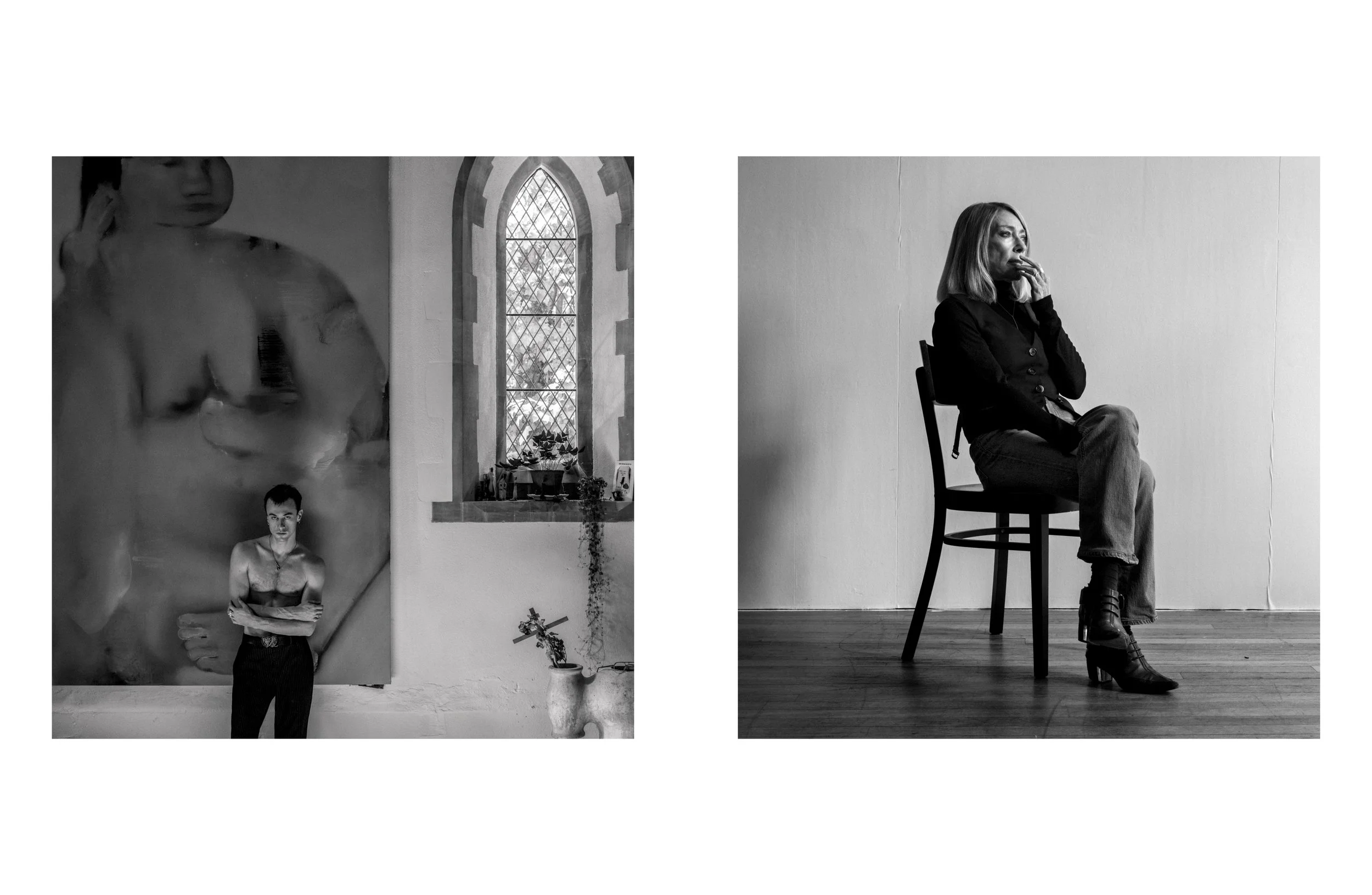
Left George Rouy, 2022
Right Kim Gordon, 2022
HP: Do you have one story to tell, as an example?
YT: Well, Nan Goldin. I really respect her work and everything she went through in her life. She'd been on my wish list for a very long time, and I tried different ways, but it never worked out. Then I saw her at some point and just asked her on the spot, and it worked. I was a bit afraid to send her the photograph in the end. I kept it on my computer for two weeks, until someone told me, "It's a great picture, you should send it to her." So, I did, and she replied that she liked it. Getting that portrait was a great help. Then, there are also people supporting, like Mick [EIC of Behind The Blinds and SHADOWPLAY Magazines], who is always keen when I bring someone up. Having the support of media is a real help.
HP: How would you say your collaboration with publications – like BTB and SP but not only – has helped the evolution of your work
YT: Media give space for our work. It costs more and more money to print, and even if I've invested a lot in my photography myself, it's not easy. It's amazing if someone gives you the space and the trust to photograph people your own way. It also helps to have a strong title behind you: people say yes more easily. What about you?
HP: I think the collaboration between photographers, artists and media is very important. It's a fight to keep the independent press, but it's essential. It's a space for creativity, expression and meaning, when everything is seen and disappears in a second on a phone screen. I recently talked with an art director about how even fashion campaign imagery has become so flat. Editorial and media are a way to push the image further and to question it. In my case, it gave me room to explore, to ask myself, despite what I learned at school, what my vision really is, and how I can actually look at things.
Left Gus Van Sant, 2023
Right Fontaines Dc Grian Chatten, 2019
YT: I agree. In the beginning, I always hated calling myself a photographer, because photographers can be extremely annoying. [Laughs] Or a photographer who knows everything about cameras and techniques, but I don't see myself like that. It's only been two years since I've been more or less okay with the word. Of course, I know how a camera, settings and light work, but it's more interesting for me to play around and make mistakes, rather than completely orchestrating a picture. That's amazing if you can do it, but it's a different kind of thing from what I do, and I think from what you do too.
HP: Definitely. So, you won't call us annoying photographers?
YT: I don't know. [Laughs] We probably can all become a bit annoying in some situations.
HP: What is your camera? You shoot analogue, right?
YT: Actually, I shoot digital most of the time. I've tried analogue and I think it's beautiful. I work a lot with Anton Corbijn, he shoots a lot of film, and his whole archive is film. There's something so beautiful in the quality of analogue, like the little mistakes, the grain. I really respect that. But it's not how I photograph. I have a Fujifilm camera that I use like an analogue camera: I never look back at the screen when I photograph — I can even keep it off.
HP: I really thought you shot only analogue.
Left The Dare, 2024
Right Kodi Smit-McPhee, 2023
YT: It's an analogue approach, let's say. Do you shoot film?
HP: Yes, but for editorials and commissions I only shoot digital. I do have a very small, old manual analogue camera, otherwise I do everything with a Sony. I really like to mix both actually.
YT: It's also interesting to make a print, something you can hold, whereas a digital photo just exists on your computer. That's what's great about publishing a book, or about an exhibition: the photograph is the object, rather than just an image on a screen.
HP: Totally. Well, now you just have to bring your exhibition to Paris.
YT: The book is in ten physical bookstores at the moment, in Tokyo, Mexico City, Paris, Brussels, Berlin, Amsterdam, and London. It's amazing to see the feedback, with people reaching out on Instagram to say they've seen your work. I don't do it for that reason, of course, but it's nice when people love the work. It feels a bit strange too, because you just do whatever you like. As we said earlier, there are many great photographers who work with lighting and elaborate setups, but that's a different kind of photography.
Left Xaviersobased, 2025
Right Yohji Yamamoto, 2026
HP: That's what is good about photography: one vision for one person.
YT: Yes indeed! Do you have a wish list of people you'd like to photograph?
HP: A very long list! At the top is Patti Smith. I dream about photographing and interviewing her. Maybe I just have to go to New York and do what you did with Nan Goldin. [Laughs] What about you?
YT: Well, it happens when it needs to happen. I don't have a specific person in mind, I let it come. Let's see who will be next!
HP: Is there anything else you want to add for today?
YT: Let me think... No! I'm very grateful for the book, and for you giving so much time and space to my work. It means a lot. I hope you can see the book soon, it should be in the Paris book store (Service Continu) by now.
HP: I'd love to. Let me know if you pass by.
YT: Sure, will do. Talk soon, and have a good day.
Yaël Temminck’s book is available here, and the exhibition is running until October 17th at Tommy Simoens Gallery
Interview by Hanna Pallot
All pictures by Yaël Temminck