THE FRUIT BASKET IS A WARNING
Antwerp, December 2025
LUC TUYMANS current show at David Zwirner in Los Angeles, The Fruit Basket, marks the Belgian artist’s eighteenth solo presentation with the gallery since joining in 1994. Thematically the exhibition picks up where his previous show The Barn (2023) left off, delving further into the deleterious effects of the conflation of image and reality. His new paintings navigate the fractured visual and psychological landscape of the United States at this moment.
He cemented his figurative painting style in the 1990s, crafting an oeuvre that uses blurry, often unsettling images derived from pre-existing photos and film, focusing on the everyday or the monumental, exploring history, power, and banality, his muted colours often meeting with eerie titles. Creating psychologically charged works, he questions representation, memory and the translation of images through the mass media, becoming a key figure in painting's resurgence amidst digital age anxieties. Characterised by a sense of constant restlessness, Tuymans’ approach is never head-on, but deeply and slowly resonates in compositions that both reveal and withhold meaning and insist on the power of imagery.
The Family, 2025, © Luc Tuymans. All rights reserved, courtesy of Studio Luc Tuymans, Antwerp, and David Zwirner
Can you explain the concepts behind your most recent exhibition, The Fruit Basket?
I was at Casa Malaparte in Capri for another project and saw a talk by the American writer Daniel Mendelsohn, who had won the Malaparte prize. During his talk, there was a nine-panelled screen behind him showing a fruit basket, in a heightened blue. That basket is a prize, which he held and then gave back – that moment clung to me because it has something to do with the element of decay. It was also in a diagonal, and before, when I was working at The Louvre on my wall paintings, I saw The Raft of the Medusa artwork by Théodore Géricault, which has that element of decay, too. So I decided to make my painting the same size.
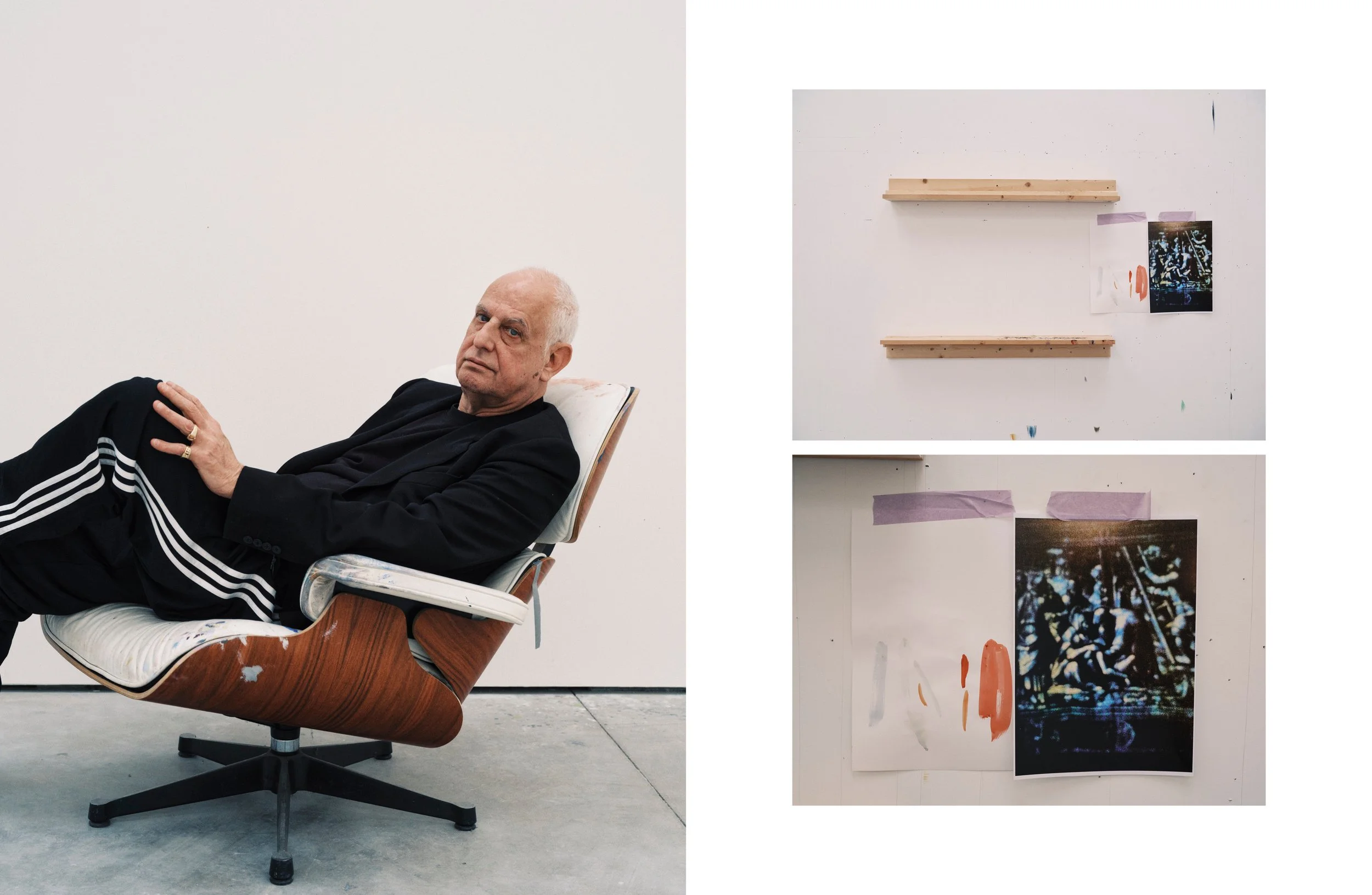
Another idea for the artwork, which came to me earlier, was based on manuscripts from the Middle Ages that were being restored, which I then heightened with a computer, enlarging the details so they become almost unrecognisable, nearly to the point of abstraction. I then found a photograph of Mark Rothko sitting in front of a painting that was in an inclination against the wall, and it gave me the idea to put a dark border around the painting, which lights up the image itself, like an image on an iPhone – a still life with digital light.
I then juxtaposed those elements with the imagery of various Americans printed in 3D, like families and a baseball player, and all these things together created a very sad show. There is also a reminiscence to Rothko because he lived in the ‘70s, which was also the age of conspiracy, and he committed suicide probably because of personal and physical things, but also perhaps because of the pressure of the art world. So, there is an element of transactional painting, made from nine pieces that are stacked together, to create one big image.
How does colour inform and enhance the narrative in these new works?
Well, there are 12 works in total, but 9 in the big one, which was painted separately.
I initially wanted to work with the Yves Klein blue for the big piece, but it didn’t work, so I started to mix my own colour, which was a combination of cobalt and deep ultramarine, one juxtaposed over the other, so you get the same vibrancy. It’s the idea of extrapolating the colour so it works on your memory, because it detaches itself from the image, and so far in the exhibition, a lot of people had to look twice at the painting before they could see the fruit basket, which is weird because it is a real construction and you can see it, but that’s because of that extrapolating colour and the light that comes out of the image.
Do you think these paintings will speak differently to an American audience than they will to a European one? Will they understand the emotional context?
You cannot force anyone to see the elements or a specific signifier, but so far, a lot of people have understood the show. They’re of course in awe with the blue painting, and with ‘The Illuminations’ which are these paintings that go back to my fascination with Rothko and this idea of the middle age – they’re beautiful but also there is sense that there is something underlying that creeps in, and then with the painting of the family at the end of the show, it becomes clear what it is about.
The Maggot, 2025, © Luc Tuymans. All rights reserved, courtesy of Studio Luc Tuymans, Antwerp, and David Zwirner
When you start a new painting, where do you begin?
The fruit basket was an image taken with my iPhone, and that’s why you see two darkened shadows at the bottom of it, which are my fingers. It starts mainly with an idea of a visual that triggers, and then it must be relevant to me and to the moment.
Painting is a medium to do with understatement, which is something that goes through and over time, so it’s not like a photograph, but it’s still a physical thing. I know my practice and all the tricks after all this time working, but still, there is a 3-hour period in the beginning where I’m at a blank with what I’m doing in terms of visibility, and I have to piece it together, which is always a scary moment and makes me nervous. But once I don’t have those nerves, I don’t think I should paint anymore, because then it just becomes work.
So, those nerves and the intensity drive you still?
Every show over the last 40 years has been a separate entity, except for the first one in 1988, when I had about 150 paintings that were highly censored, and I selected 14 of them.
I never work on two or three paintings at the same time, and before I start, it’s a huge process to figure out what and how I’m going to paint. Once everything is there, I choose a day and execute the painting, and it’s very intense, so I must prepare mentally. At that point, I don’t want to think on any intellectual level; I just want the knowledge to go to my hands and concentrate on that.
Shows come along organically to a certain point, but mostly they are an inheritance of the point where I stopped painting from 1980 to 1985, because I felt it was tormenting and existential, and I couldn’t get the necessary distance I needed from it, so I started to film instead. In the end, I went from 8mm to 16mm to 35mm to make a real movie and found out I was very bad at scriptwriting, so I came back to painting, but my vision was informed through the idea of a lens, which is all about the approach and how you create distance.
Having addressed so many themes in your paintings, how do you use memory in your work? And how do you balance the convenience of digital imagery with the depth and nuance that comes from working from memory?
They have one thing in common: they’re incomplete. When I go on vacation, I never take pictures because it disturbs the memory of my holiday. It’s like people who watch Netflix and binge-watch all these awesome, gruesome series. Go and read a book – it’s far more interesting for your brain.
What initially drew you to making art?
It goes back to being a kid. I was borderline autistic, blonde and blue-eyed, a beautiful kid, but very shy and extremely bullied. My father was Flemish and my mother Dutch so in the holidays, I would go to youth camps with kids in Holland where they did sports, a bit like Tour de France, and one day, with about 150 kids around me, I won the yellow sweater, had to go on stage and say, “This is what I’m going to become…” It’s like asking an actor why they want to act, because everyone wants to be fucking James Bond, you know! It’s a very initial point, but I knew this was my ability and what I was going to do, and of course, I didn’t know what an artist did, but that came much, much later.
Do you have any creative rituals or routines you could tell us about?
Well, I stopped drinking because I need to be completely sober and mentally prepared to paint. I also choose a day to paint, such as a Thursday – I don’t paint every day of the week, unless I need to go back to a painting if it’s very detailed. When I get to the studio, I start a painting and finish it, or as close to finishing it as I can, so I know if it’s worked or not, and if not, I start again. In the old days, I had to overpaint works because I had no money for new canvases, but that’s not the case now, so I can afford to start again.
The Fruit Basket, 2025, © Luc Tuymans. All rights reserved, courtesy of Studio Luc Tuymans, Antwerp, and David Zwirner
When you create art, it’s open in terms of the meanings it can generate. Is that something that you come across often, where meaning or interpretation comes out of left field?
When that happens, it’s very lucky, and that’s a surprise, an addition to what you’re doing. When a painting works, I’m always amazed because, as I mentioned, I’m always nervous that I cannot do it anymore, and that’s a permanent feeling that’s always there.
As for the way the public sees the work, we shouldn’t kid ourselves, because contemporary art has become democratic in its utmost convictions, so there is a huge difference between how art was created centuries ago to how it is now, because the public is taken into account. It makes it less radical in a certain sense, so it’s like there is this extreme blackmail and dependency upon the element of approval that is built into the system, which is interesting because it’s a perversion and something one should be aware of.
In view of that, what would be your advice to emerging young artists today, especially those finding it difficult to find gallery representation or who deliberately want to opt out of the white cube system?
It's always more interesting to show your work in a place that’s not a white cube, like my very first show in an empty swimming pool in Ostend in 1985, which was a two-day exhibition for which I sent out lots of invitations, and nobody came, except my mother. She got into the empty pool and started to cry. I was on the balcony looking at my work, which was for the first time out of my small studio, and I then understood it was going to be ok. I think it’s difficult for young artists now, but if you want to do something outside of the commercial system, you have to organise yourself as a community; that’s the only solution. I think younger artists are doing that increasingly. It’s less isolating and creates more substance, and it’s more meaningful and rewarding on an individual level.
Illumination II, 2025, © Luc Tuymans. All rights reserved, courtesy of Studio Luc Tuymans, Antwerp, and David Zwirner
The exhibition The Fruit Basket by Luc Tuymans is on view at David Zwirner, Los Angeles, from February 24th to April 4th, 2026.
Interview by Kate Lawson
Photography by Jorre Janssens
Special Thanks to Fabian Jean Villanueva